Any candidate who wished to seek the group’s endorsement, regardless of party, was asked to complete a questionnaire which was reviewed by the Ulster People screening committee. If the responses showed a strong alignment between the candidate’s views and actions and Ulster People’s platform, candidates were invited to interview with the screening committee, after which, the committee voted to recommend endorsement (or not). The voting members of Ulster People made the final endorsement decisions.
Our County Government makes decisions that affect our daily lives—from infrastructure, policing, and public health, to our environment, economy, and rights. Ulster People is proud to endorse 13 candidates for local government, who, if elected, will shift the balance of power and make real change possible:
March Gallagher
for Ulster County Comptroller
and
12 Candidates for the Ulster County Legislature:
What does our County Legislature do? How does it work?
Any candidate who wished to seek the group’s endorsement, regardless of party, was asked to complete a questionnaire which was reviewed by the Ulster People screening committee. If the responses showed a strong alignment between the candidate’s views and actions and Ulster People’s platform, candidates were invited to interview with the screening committee, after which, the committee voted to recommend endorsement (or not). The voting members of Ulster People made the final endorsement decisions.
Co-sponsored by Citizen Action of New York, Nobody Leaves Mid-Hudson, UACT, Mid-Hudson Valley DSA Ecosocialist Working Group, Citizens for Local Power, Sunrise Movement Hudson Valley and Ulster Immigrant Defense Network
We (the people) were told not to be disappointed. Tabling the legislation (in other words, not allowing the legislators to vote so we could have on record HOW they voted), was for the time being the best possible outcome. A failed vote in the full legislature would take the wind out of any forward movement, further delaying a reintroduction. It was decided that a postponement was the best chance for the future of the legislation.
It was pointed out to us that the two Republicans on the committee, both of whom have been clear about their opposition to this bill, were eager to allow it to move forward to a full vote. It was the Democrats who voted to postpone.
The reason given: An amendment to the 2020 County budget, which would have funded extra BoE staff to oversee the new program, had failed to pass in the Legislature. Two Democrats broke ranks and voted against.
Come January, the party balance in the new Legislature will remain the same 12 Dems and 11 Reps. Clearly, that doesn’t guaranteed passage of this important legislation. We need the Dems to stick together.
Ulster People will be extremely disappointed if Proposed Local Law #10 of 2019 is not passed.
We will be even more disappointed if legislators are not given the opportunity to weigh in individually. Without a vote, we (the people) are deprived of an important means of holding our elected officials to account. That is especially true of those who promised to support this effort in return for our endorsement.
TAKE ACTION! Please contact any or all of the Laws & Rules committee members before 6:30 PM Monday Dec. 16, especially if you live in their districts, and urge them not to table Comprehensive Campaign Finance Reform (to allow the vote to go forward).
Check back here on Tuesday to find out what happened on Monday evening in the Laws and Rules Committee meeting.
If the committee decides to let this legislation go forward to a vote, you are all urged to come take advantage of the public comment period before the meeting begins. Plan to arrive a little before 7 to sign up.
Let our legislators know how much we care and that we are watching how they vote. Even if you don’t want to speak, your presence is an important way to show your support.
Our legislators need to hear from you before they vote on Proposed Local Law No. 10 of 2019: A Local Law Regarding Campaign Finance Reform!
Mark Your Calendars! Please Come!
PUBLIC HEARING ON CAMPAIGN FINANCE REFORM Tuesday, November 12th at 6PM Ulster County Office Building (6th Floor) 244 Fair Street, 6th Floor, Kingston, NY 12401
The hearing will start a little after 6, but show up by 6 to sign up for a chance to speak. Your comments must be limited to 2 or 3 minutes. (Best to time yourself in advance rather than having your best lines cut.)
This is your chance to let our legislators know how important you think passage of this legislation is for the health (perhaps even survival) of our democracy.
big donors will have less influence on our elections.
pay-to-play corruption in government will be reduced.
candidates who couldn’t afford to wage competitive campaigns now can.
we are more likely to have a more diverse group of candidates to choose from
and elected officials who more accurately represent our communities.
Ulster County could have real comprehensive campaign finance reform for local and county-wide races before the end of the year!
The Numbers
…have not changed since our last update:
Local candidates, having qualified for public funds by raising $500 in individual small donations (under $100), including at least 50 individual donations, will have their contributions matched at a 5:1 ratio up to a maximum of $2500. Candidates receive their share of public funds as soon as they qualify.
County-wide candidates must first raise $15,000 in small donations (under $100) from at least 150 individual donors to qualify for the $23,000 in public matching funds available.
Contribution limits (individuals, partnerships, political committees, labor organizations) are set at $3500 per election cycle for county-wide races and at $650 for local races (both considerably less for those doing business with the county).
Note: A possible point of contention going forward is the 5:1 ratio at which small campaign contributions are to be matched with public money. 5:1 sounds like candidates will get more money. That’s not true. The maximum amount available to a candidate remains unchanged whether the matching ratio is 10:1, 5:1 or 3:1.
At 5:1, local candidates would receive the entire $2500 in public matching funds available to them as soon as they have raised their qualifying $500 in small donations
At 3:1, they would receive only $1500 when they have raised the initial qualifying $500, leaving $1000 still available. To receive that final $1000, they would have to raise another $333 in small donations ($999).
But the maximum amount available to each candidate remains unchanged.
For County-wide candidates, the ratio (5:1 or 3:1) makes no difference at all. They must first raise $15,000 in small donations (under $100) from at least 150 individual donors to qualify. Either a 3:1 or a 5:1 matching ratio gets them well over $23,000, which is the maximum amount they can receive in public funds.
Now is the time!
The numbers may not have changed since our last post about the progress of this legislation, but the number of supporters in the Legislature may yet change when all of the absentee ballots are counted. That could work in our favor– or not.
Campaign Finance Reform is something we all care about.
Let’s make sure it happens during this legislative session!
Read our past coverage on campaign finance reform in Ulster County:
The hearing will start a little after 6, but show up by 6 to sign up for a chance to speak. Your comments must be limited to 2 minutes. (Best to time yourself in advance rather than having your best lines cut.)
This is your chance to let our legislators know how important you think passage of this legislation is for the health (perhaps even survival) of our democracy. For more information, see our post!
Join us at a phonebank to call Our Revolution supporters to remind them to vote for Dave Clegg for DA and John Schoonmaker for Ulster County Legislature!
Please bring a laptop, cellphone, and a headset (if you have one).
Ulster People: Mark your calendars! This one is for us!
A public hearing has been scheduled for Proposed Local Law No. 5 of 2019, the “Food Waste Prevention and Recovery Act”, on Thursday, October 10, 2019 at 6:15 PM at the Ulster County Office Building, 6th Fl., 244 Fair St, Kingston.
Please come and make your voices heard!
Food Waste, you say? What’s the big deal?
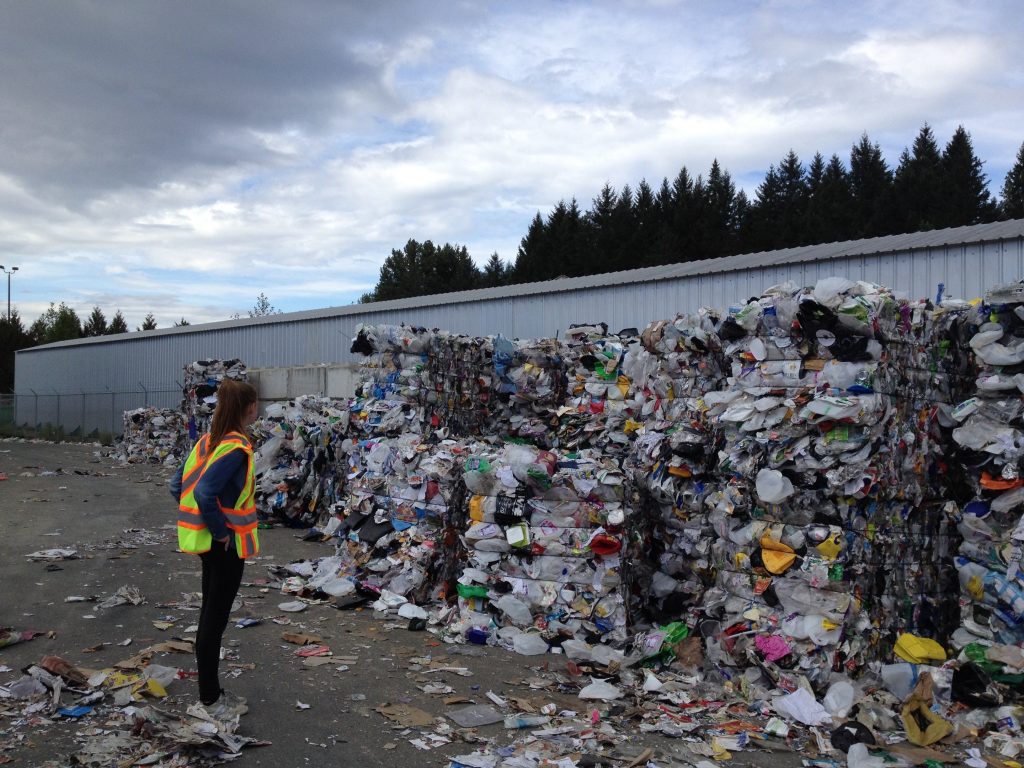
Americans waste a lot of food–about 133 billion pounds a year. That’s roughly a third of all the food produced in the U.S. While most people understand what a tragedy it is to waste so much food when there is so much hunger, what many fail to understand is that throwing food away contributes to another global crisis: climate change.
When food ends up in landfills and rots, it produces huge quantities of methane–maybe not as much as cars or cows, but it’s in third place. Methane is about 30 times more potent than carbon dioxide as a heat-trapping gas.
Fun Fact: Ulster County throws away 40,000,000 pounds of food scraps each year. That’s about 30% of the trash we send to landfills upstate.
So, YES, it is a big deal. We all stand with Greta Thunberg when she says, “Right here, right now is where we draw the line.” Right? Well, the “Food Waste Prevention and Recovery Act” is about large-scale composting, and composting wasted food reduces the environmental pollution that contributes to global climate change. It also saves money.
NO, composting food scraps will not solve global climate change–or even the problem of what to do with the rest of our garbage when the Seneca Meadows landfill closes in 2025–which is also a big deal. But one thing at a time. Requiring large-scale producers of food waste to compost is a start. And it’s a line we can draw now.
Ulster County is Ready!
Visionary environmentalists in Ulster County have been composting here for decades. Mohonk Mountain House, for example, has modeled stewardship of its natural resources by composting tons of consumer food waste every month and using the end-product to fertilize it’s famously spectacular gardens. Similarly, the Frost Valley YMCA has operated what was, at its inception in 1990, one of the few institutional food waste composting systems in the entire country. The facility serves 30,000 guests annually, composting all of the food waste for use in the camp’s greenhouses. That same year, New York State’s Department of Corrections began a composting program which 30 years later employs up to 1100 inmates at 29 state facilities. Aside from savings in transportation and tipping fees and methane reduction, the program provides relevant and productive inmate work experiences.
In 2012, the Ulster County Resource Recovery Agency (UCRRA) began an organics recovery pilot program to create an alternative to landfill disposal of food waste. Before the program began, the County was sending 20,000 tons (40,000,000 pounds) of food waste every year to the Seneca Meadows landfill, 250 miles away. In the last 3 years of operation,
7859 tons or organics have been composted,
$809,498 in tipping fees have been saved,
224 tractor trailer transports didn’t make the 250 mile run, and
21,280 gallons of diesel fuel was saved.
These programs, and others like them, including Greenway Environmental Services and the Community Composting Company, are already up and running in Ulster County. They have demonstrated the practicality and economic feasibility of mandatory county-wide composting for large food waste producers. They have reduced the cost of disposal and transport, reduced greenhouse gas emissions, and created an end product that improves soil quality and carbon sequestration, reducing the need for chemical fertilizers and pesticides. They demonstrate that Ulster County is ready to take this on.
Once Again, We Are Ahead of the Curve
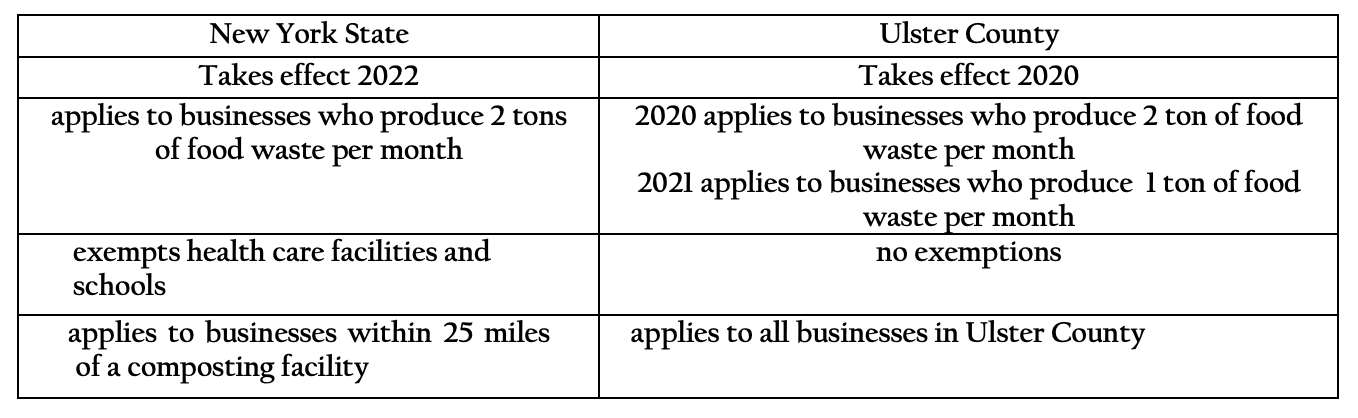
Ulster County’s Climate Smart Commission already encourages local businesses to participate in composting programs as part of its new Green Business Challenge, but participation has been voluntary. That is going to change in 2022 when a new state law (S1508C) goes into effect requiring businesses producing two tons of food waste per month to compost.
But it could happen sooner in Ulster County.
The “Food Waste Prevention and Recovery Act” would take effect in 2020. We would be two years ahead of the game. The State law exempts healthcare facilities, schools and businesses more than 25 miles from a composting facility (the vast majority). Our law would apply to all businesses in the County that produce 2 tons of food waste a month, and it will eventually cover even smaller generators, making the transition to the State law requirements far easier.
Ulster People Make a Difference! Let’s Make This Happen!
As with the plastic bag and straw legislation, Ulster County has yet another opportunity to set the environmental standard for Albany and other NY Counties.
Showing up for public hearings is one of the most effective ways Ulster People can show our support for those legislators who support our progressive platform. It is an effective way to make our aspirations and our concerns visible to our legislators– and make sure that our voices have been heard by the County Executive when this legislation lands on his desk.
Please show up on Thursday, October 10th!
Tell our legislators that right now is where we draw the line!
Early Voting has finally come to New York State. Now you have one more convenient option to cast your ballot this election season.
For nine days – October 26th – November 3rd you can vote at one of 7 polling sites around Ulster County. Hours of operation vary but include a mix of day, evening and weekend hours.
Thanks to new technology investments, early voting allows you to visit the polling site that fits your needs – Early Voting sites will be open in Woodstock, Kingston, Town of Ulster, New Paltz, Ellenville, Accord, and Highland.